





AI is no longer just being tested. It is running continuously in production, at scale, across real customer interactions.
That shift, from experimentation to operation, is what makes the inference economy worth understanding.
When AI becomes part of live products, every request, recommendation, classification or automated action can trigger model execution. At scale, those individual events become a new operating layer for software businesses, digital service providers and partner ecosystems.
This article opens CloudBlue’s Inference Economy Series by defining the concept and explaining why it matters now.
Training builds the model. Inference runs it.
AI training and AI inference are related, but they are not the same thing.
AI training creates or improves a model. It is usually planned, resource-intensive and development-focused.
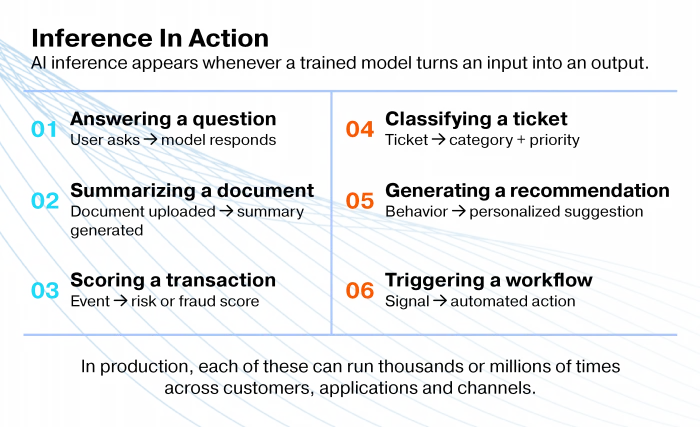
AI inference uses the trained model in response to an input. It happens when an AI tool answers a question, summarises a document, classifies a support ticket, scores a transaction, recommends a product or triggers an automated workflow.
A simple way to frame the difference is:
- Training builds the model.
- Inference uses the model.
- Training is usually a project.
- Inference is an operation.
That distinction matters because production AI does not run once. It runs repeatedly across customers, applications, APIs and channels. That operational continuity is what the inference economy is built around.
Why AI inference is different from traditional software usage
Traditional software was built around access.
For decades, commercial software has often been sold through:
- licences;
- seats;
- subscriptions;
- feature tiers;
- account-level entitlements.
A customer either had access to the product or didn’t. Usage existed, but the commercial and operational model was usually built around permission.
AI-enabled services behave differently.
Two customers on the same product tier can exhibit very different levels of activity depending on how often they trigger AI workflows, how complex those workflows are, and how many model executions occur behind each interaction.
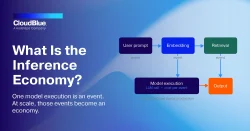
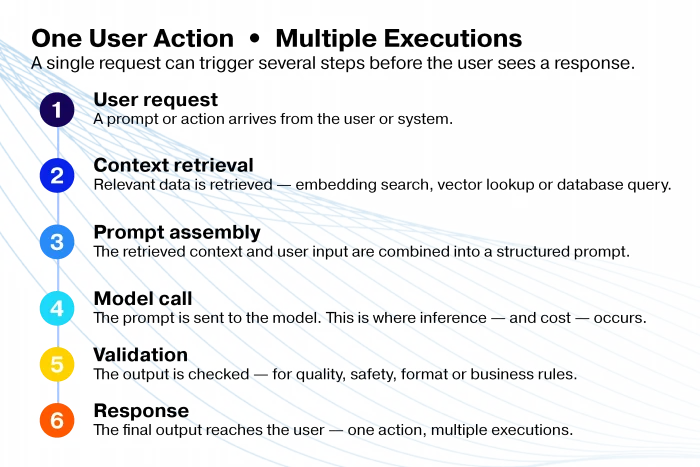
For example, one AI-powered search request may involve:
- a user request;
- context retrieval;
- prompt assembly;
- a model call;
- output validation;
- a final response.
To the user, it looks like one answer. In production, it may be a chain of measurable events.
That chain is one of the core units of analysis in the inference economy.
Usage is no longer just a sign that someone has access to the product. It becomes a measurable operating signal in its own right.
So, what is the inference economy?
The inference economy is the operational and commercial system that emerges when AI models run continuously in production.
It appears when model execution becomes a repeated layer beneath the customer experience, rather than an occasional technical process.
In practical terms, the inference economy:
- runs continuously in the background of AI-enabled services;
- creates measurable activity at the event level;
- places new demands on infrastructure, observability and reliability;
- influences how AI-enabled services are built, delivered and scaled.
Traditional software systems were largely designed for account-level usage. The inference economy operates at the event level.
That gap between the existing commercial model and the operating reality that has emerged is exactly what this series sets out to address.
Where the inference economy appears in production
The inference economy is already visible across many AI-enabled services.
It is not limited to generative AI.
It appears wherever AI is used repeatedly: to classify, score, recommend, retrieve, summarise or automate.
Some of the clearest examples include:
Customer support platforms
AI classifies, routes and responds to large volumes of tickets. The model runs with every interaction, not once per session.
Document intelligence tools
Models extract, summarise and structure information as documents arrive. In high-volume environments, this can create repeated inference activity across many documents, workflows and users.
Cybersecurity products
AI supports threat detection, anomaly scoring and risk analysis, often running inference on transactions, user behaviour or network events.
AI-powered search
Systems retrieve context and generate responses based on user intent. Each search may trigger multiple model calls before a result is returned.
Recommendation and personalisation engines
AI refines offers, content or product suggestions based on behavioural signals, with inference happening at the moment of each user interaction.
Workflow automation tools
Models trigger actions across systems based on user behaviour or operational signals. Inference is embedded in the operational flow rather than surfaced only as a visible feature.
In each case, AI is not just a surface-level feature of the product. It becomes part of the operating layer beneath the service.
H2: Why the inference economy matters now
The inference economy is not a future state. It already exists wherever AI is running in production.
The challenge is that many organisations have not yet named it, measured it or built their operating model around it. That means they are managing a new operational reality with frameworks designed for a different one.
Once model execution becomes part of everyday product usage, the questions change.
It is no longer enough to ask whether the AI feature works.
Providers also need to understand:
- What happens each time the model runs?
- How many events sit behind one user action?
- Which models are being used;
- How usage varies across customers, applications and partner channels;
- What happens when that usage scales?
- Whether their infrastructure and commercial systems are ready for that scale.
As more AI moves from experimentation into live products, inference becomes a more important operating layer to understand.
The following articles in this series will explore the difference between training and inference in more depth, what happens inside a single inference event, how inference affects software pricing models and what changes when AI services move through partner channels.
The starting point, though, is this: inference is no longer just a technical process. In production, it becomes a defining layer of modern software, and understanding it is no longer optional.
Quick reference: FAQ
What is the inference economy?
The inference economy is the operational and commercial system that emerges when AI models run continuously in production. It describes how repeated AI usage creates measurable activity across applications, customers, APIs and partner ecosystems.
What is AI inference?
AI inference is the use of a trained AI model to produce an output from an input. It can generate an answer, prediction, classification, recommendation or automated action.
How is AI inference different from AI training?
AI training creates or improves a model. AI inference uses that model in a live product, workflow or system. Training is usually periodic and development-focused. Inference happens whenever the AI service is used.
Is the inference economy only about generative AI?
No. Generative AI is one prominent example, but the inference economy also includes AI used for search, classification, recommendations, cybersecurity, fraud detection, document processing and workflow automation.
Why does the inference economy matter for software providers?
It matters because production AI creates event-level usage that does not fit neatly into traditional access-based models. Providers need to understand what happens each time a model runs, how that activity scales and how it affects infrastructure, performance, customer experience and future commercial models.