



For years, Microsoft partners had a familiar safety net when managing subscription renewals.
If a customer had not yet confirmed what they wanted to do at the end of a subscription term, there was usually time to work it out. The traditional 30-day grace period gave MSPs, resellers and distributors breathing space while renewal discussions continued and internal approvals moved forward.
That approach no longer works.
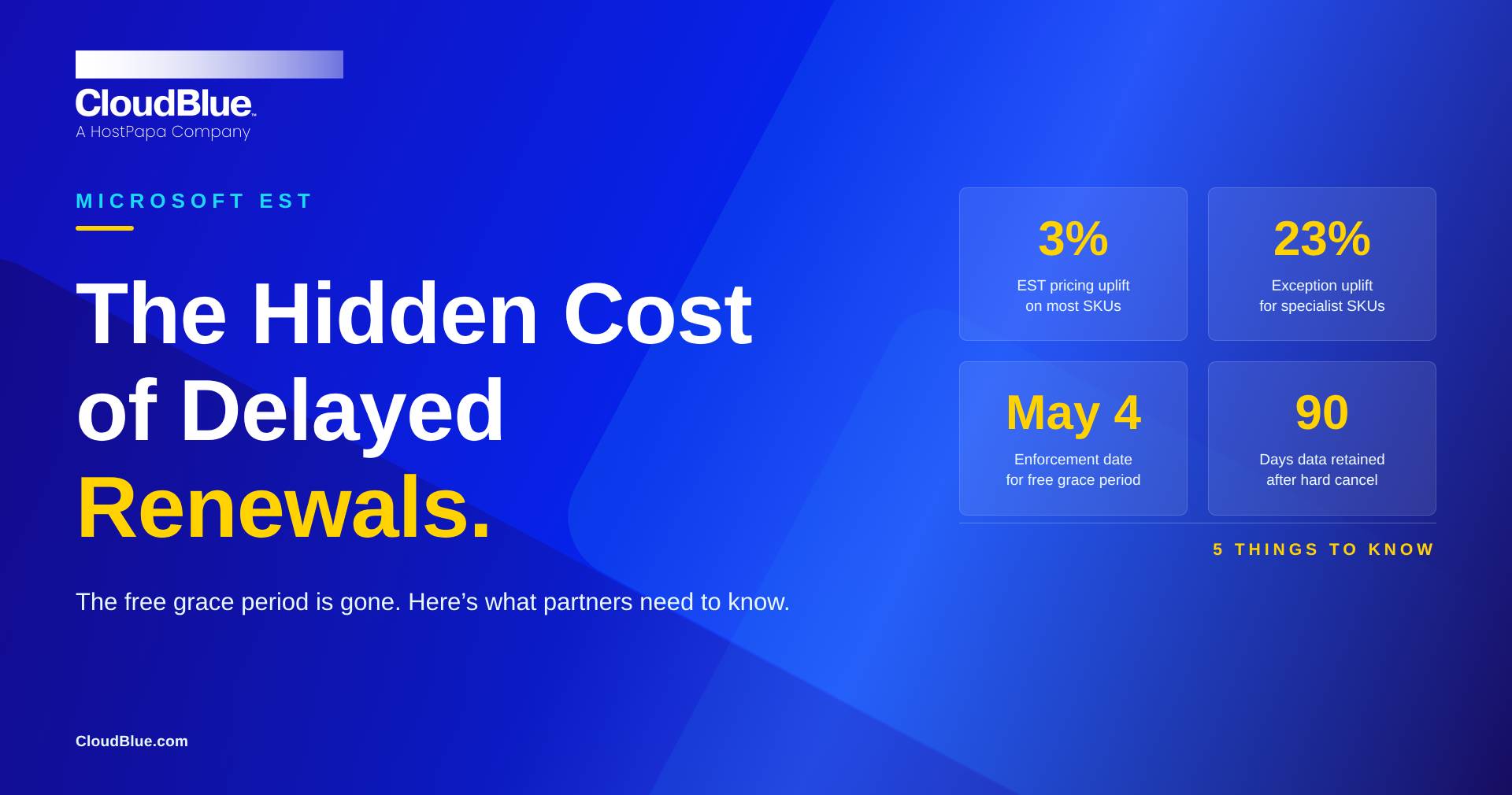
As of May 4, 2026, Microsoft officially ended free service access for eligible non-renewed subscriptions. In its place comes Extended Service Terms (EST), a paid, monthly billed continuation of service designed to prevent disruption when no renewal decision has been made.
For partners, this is more than a licensing update.
It changes how renewal risk affects margins, billing predictability and operational planning.
Simply put, Microsoft has introduced a new cost to delayed decision-making.
This article explains what partners need to know about Microsoft EST, why it matters to finance and operations teams, and what actions to take before unexpected costs start appearing in reconciliation files.
The Free Grace Period Is Over
The biggest operational shift is the removal of the familiar “wait and see” period.
Previously, subscriptions that reached the end of the term without renewal could continue temporarily while partners finalized the customer’s next step.
Now, partners effectively face three choices.
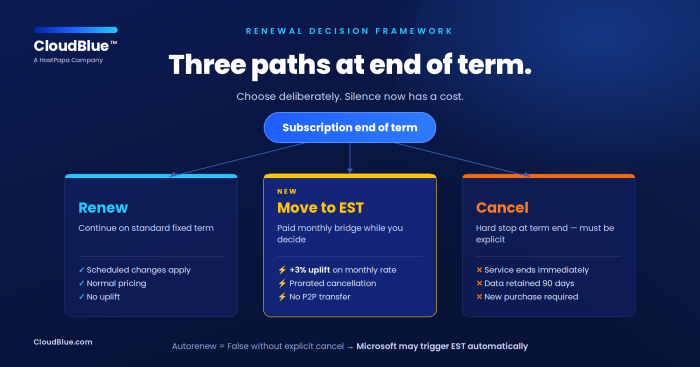
Renew the Subscription
Business continues as usual. Partners can renew into a new fixed term, maintain existing services or apply scheduled changes.
Cancel at Expiration
This is now a hard stop.
Services end immediately at term completion. Although customer data may remain available for a limited retention period, access to the service stops and cannot simply be reactivated without a new purchase.
Move to EST
EST becomes a paid bridge between subscription expiry and a longer-term decision.
For partners waiting on customer confirmation, procurement delays or internal approvals, EST can maintain continuity while avoiding service disruption.
The important shift is behavioural.
A subscription quietly expiring is no longer neutral. It now results in either immediate service loss or additional paid usage.
That means renewal conversations need to happen earlier than before.
EST Adds a New Margin Consideration
Microsoft designed EST for flexibility.
Partners should understand, however, that flexibility comes at an increased cost.
Most EST subscriptions are billed at the current monthly term price plus a 3% uplift. For specialised SKUs with no monthly term, a 23% exception uplift may apply.
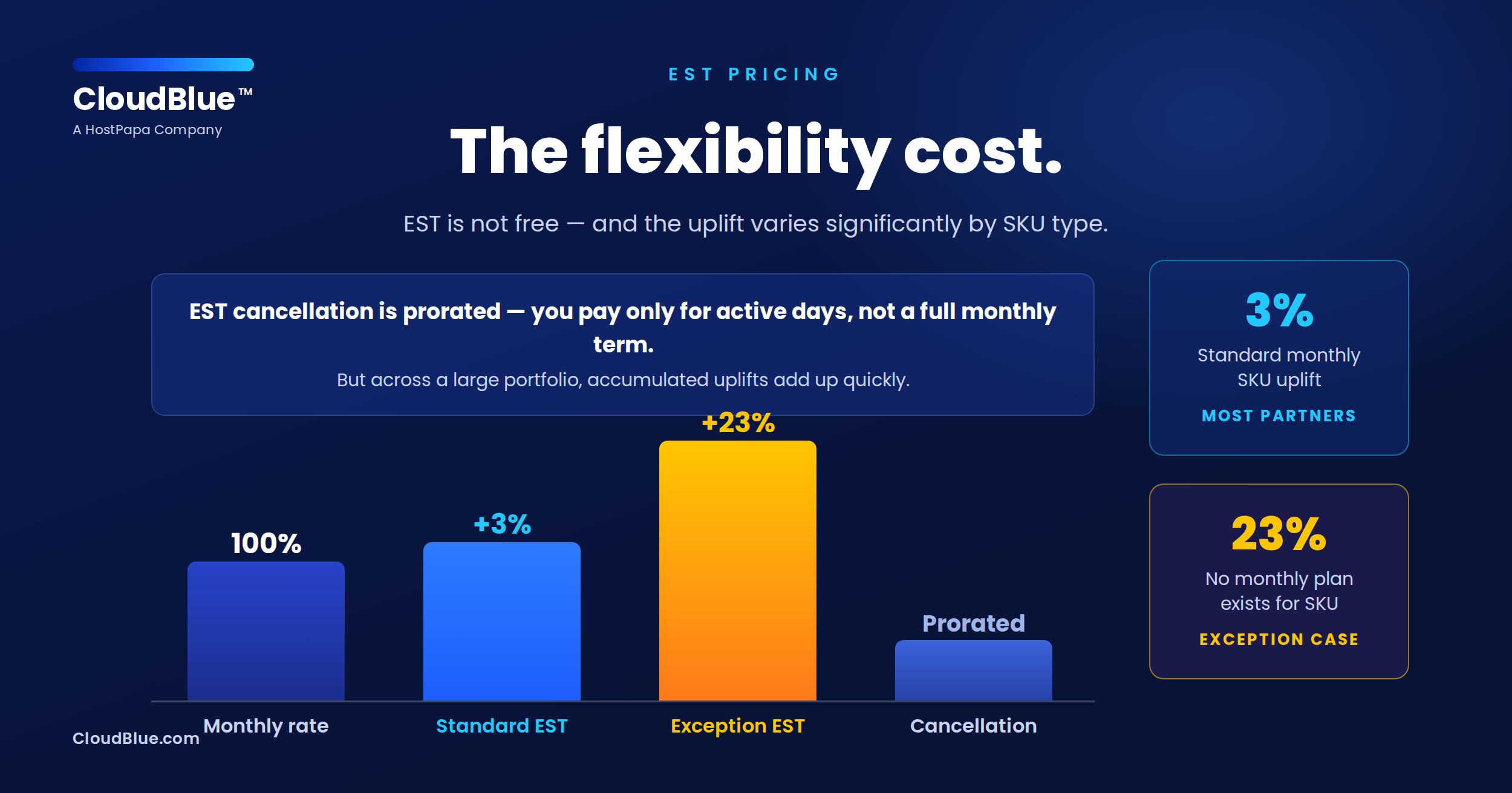
On an individual subscription, the increase may appear small.
Across a portfolio of delayed renewals, uncertain customers and manually managed subscriptions, however, those additional costs can quietly accumulate.
The good news is that EST cancellations are prorated. Unlike a standard monthly term, partners pay only for the exact number of days EST remains active.
There is, however, an important operational consideration.
EST pricing currently does not support preview visibility. Billing teams can only see pricing for the current month, reducing the advanced forecasting that many partners rely on for financial planning.
What This Means for Finance Teams
EST should be treated as a short-term operational bridge, not a passive default state.
Without visibility into which subscriptions are transitioning, finance teams may only discover the impact when unexpected costs appear in reconciliation files.
“Autorenew = False” No Longer Means What Many Partners Think It Means
One of the biggest risks sits inside a setting many partners already rely on.
Historically, Autorenew = False often acted as a placeholder. It meant the customer had not yet committed to renewal, while the grace period created time to decide.
Under Microsoft’s new model, that assumption becomes risky.
If an eligible subscription reaches term end without an explicit cancellation or renewal decision, Microsoft may automatically transition it into EST to maintain service continuity.
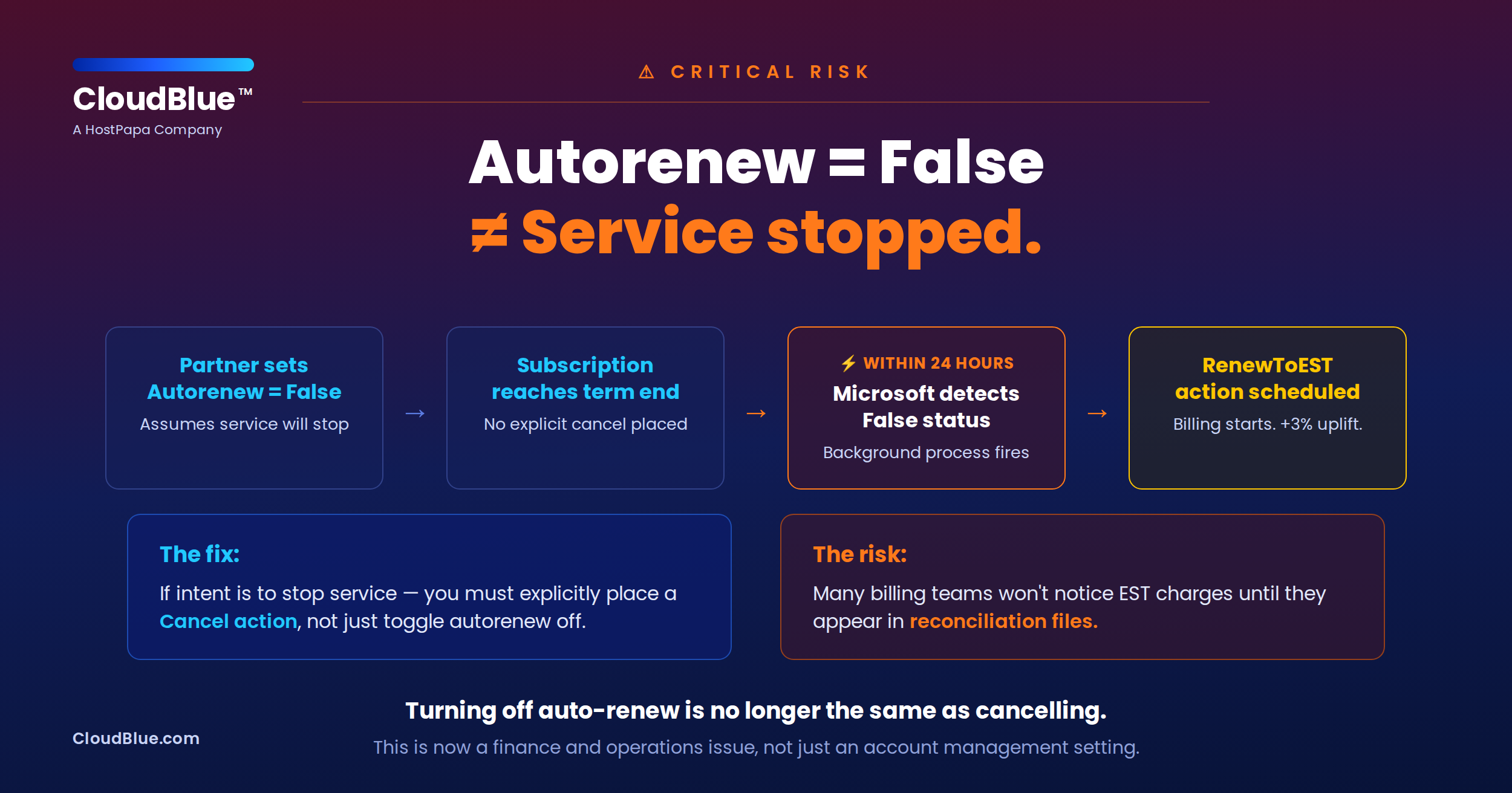
In practical terms, turning off auto-renewal no longer guarantees service will stop.
If the intention is to fully end service, partners now need to take explicit cancellation action.
That distinction matters.
Because many partners may not notice EST transitions until additional costs begin to appear in reconciliation or billing files.
What used to be a customer management issue increasingly becomes a finance and operations issue.
4. Visibility Into Renewal Exposure Matters More Than Ever
The challenge is not understanding EST.
The challenge is identifying where renewal risk already exists.
For many partners, the real operational issue will be visibility: identifying subscriptions approaching the end of term without confirmed customer intent before they become an unexpected cost.
That means reviewing:
- subscriptions with Autorenew = False
- customers approaching renewal without a confirmed commitment
- subscriptions already eligible for EST
- pending transitions that may affect billing or reconciliation
Without visibility, renewal management becomes reactive.
And reactive renewal management is often expensive.
5. EST Can Create Operational Blockers Beyond Billing
The impact of EST does not stop at pricing.
Partners should also be aware of technical and operational constraints.
Partner of Record Validation
Moving a subscription into EST requires strict Partner of Record (PoR) validation.
Distributors should ensure reseller partner IDs are valid before confirming a transition. If the PoR information is incorrect, the EST move will fail.
Partner-to-Partner Transfer Limitations
Subscriptions already in EST are not eligible for Partner-to-Partner (P2P) transfer.
For partners managing customer migrations, acquisitions or offboarding projects, this matters.
A subscription left in EST for convenience today may create avoidable operational friction later.
If a transfer is required, the subscription typically needs to revert to a standard base SKU before the transfer can proceed.
Managing EST Exposure with CloudBlue
The challenge for many service providers is not understanding EST rules. It identifies where exposure already exists across a subscription portfolio before costs are incurred.
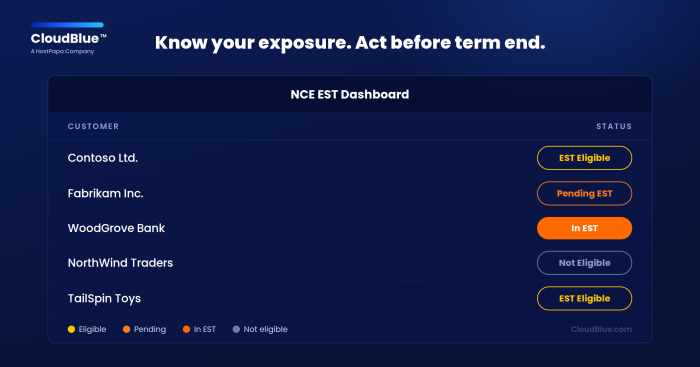
CloudBlue’s NCE EST Dashboard helps partners proactively manage that risk by providing visibility into EST Eligible, Pending EST and In EST subscriptions in one place.
Instead of reacting after charges appear in reconciliation files, teams can identify renewal risk early and take action before subscriptions move into EST.
Partners can:
- Identify subscriptions that are EST Eligible or already in EST
- Monitor Pending EST transitions before they execute
- Filter by customer name or subscription ID to prioritise high-value accounts
- Take action directly by renewing, cancelling or confirming a transition before the point of no return
The dashboard also helps surface Partner of Record validation issues before a transition is attempted, reducing the risk of failed EST moves at the worst possible moment.
For finance and billing teams, this operational visibility helps anticipate EST-related charges before they become a reconciliation problem.
What Partners Should Do Now
What Partners Should Do Now
Microsoft’s move to Extended Service Terms changes the cost of doing nothing. A subscription that quietly expired in the past may now trigger paid continuation, unexpected reconciliation issues or avoidable margin erosion.
For partners, the priority is to move renewal management earlier in the process, using portfolio visibility and customer intent data to decide, before term end, whether each eligible subscription should be renewed, cancelled or confirmed as EST.
The partners most likely to manage this shift successfully will not necessarily be the ones with the largest operations teams. They will be the ones who identify renewal risk early and act before it becomes a billing problem.
Because under Microsoft’s new model, delayed decisions are no longer free.
Quick Reference: FAQ
What are Microsoft Extended Service Terms (EST)?
Extended Service Terms (EST) are a paid continuation of Microsoft subscription services after the original term expires. They are designed to prevent service interruption when no renewal decision has been made
What happens if a Microsoft subscription is not renewed?
Eligible subscriptions may transition into EST, where monthly billing continues with an uplift, unless the partner explicitly cancels the subscription.
Does “Autorenew = False” cancel a subscription?
No. Under Microsoft’s updated policy, turning off auto-renewal does not necessarily stop service. Eligible subscriptions may automatically transition to EST unless an explicit cancellation is requested.
How much does Microsoft EST cost?
Most EST subscriptions include a 3% uplift above the monthly subscription rate. Some specialised SKUs may incur a 23% uplift.
Why should partners care about EST?
EST affects renewal timing, billing predictability, reconciliation and margin management. Without proactive oversight, unexpected costs may appear across subscription portfolios.